
Hurricane Previous Residents by Era
No single roll covers the full life of a Hurricane property. Modern parcel data identifies the current tax record, while deeds document transfers and legal descriptions. Directories and census schedules add the household layer. Permits and newspapers can date changes or explain why a name appears at a place. The table separates what has been verified from what still requires a call or an in-person search.
| Hurricane source | Verified span | Access point | Evidence supplied |
|---|---|---|---|
| Putnam deed index and books | Index 1848-1968; deed books 1848-1900 on Archives microfilm | Putnam County Clerk, RECORDhub, WV State Archives | Grantor, grantee, transfer, book/page, and legal description |
| WV Property Assessment | Current and prior-ownership modes; dates vary by parcel | State online assessment search | Owner, situs, mailing address, parcel ID, sale and deed references |
| Regional directories | Digitized titles 1839-1929; Charleston Polk run 1908-present | William & Mary, WV Archives, Kanawha County Public Library | Names, addresses, spouse or work notation when printed |
| Federal census | Public schedules released under the 72-year rule | NARA, FamilySearch, and library databases | Households, relationships, ages, and enumeration place |
| Hurricane Breeze | Microfilm from May 23, 1913 to present | WVU WVRHC, current e-edition, newspaper search | Obituaries, notices, sales, local names, and address clues |
| Hurricane permits | Current form and department records; no public index found | City Building and Code Enforcement | Project address, owner or applicant, work scope, and inspection trail |
For recent previous residents, start with the assessment card and the latest deed. For an early owner, use the legal description to cross from RECORDhub to archived books. For occupants who did not own the property, work from a directory or census year and then check the local newspaper. Hurricane-only directory coverage has not been confirmed, so regional volumes must be checked title by title.
Start With Hurricane Parcel Facts
The WV Property Assessment search is the quickest way to anchor an address. Select Putnam County before using dependent parcel fields. A street-name search accepts any part of the physical street address. Advanced mode adds mailing address, deed book, page, legal description, building year, and structure fields. Prior Ownership is also a visible search mode.
Copy the full parcel ID, physical or situs address, owner name exactly as shown, mailing address, legal description, deed book/page, and sale data. Situs means where the parcel lies. The mailing address is where the tax notice goes, and it may be a post-office box or a place outside Hurricane. That difference is a useful lead, but it is not proof of who lived in the house.
| Assessment field | Use in a backward search |
|---|---|
| Full Parcel ID | Keeps the same tract in view when addresses or owner names change. |
| Legal description | Connects the parcel to lots, blocks, additions, plats, and older deeds. |
| Deed book and page | Points to the recorded instrument behind the current assessment entry. |
| Prior Ownership mode | Offers a second lead that should still be checked against recorded deeds. |
Walk Hurricane Deeds Backward
The Putnam County Clerk records deeds, deeds of trust, liens, releases, plats, land contracts, leases, and other property instruments. RECORDhub is the online doorway, but its public page does not state the current starting date or full image rules. A sound Hurricane previous residents search therefore treats the portal as one channel, not the whole archive.
- Pull the present owner, parcel ID, legal description, and deed citation from the assessment record.
- Open the Putnam RECORDhub portal and locate that owner's purchase as grantee, the buyer.
- Record the seller, who is the grantor, plus the instrument date, recording date, book/page, and exact land description.
- Search that seller as an earlier grantee. Repeat while the parcel description remains consistent.
- When online coverage ends, call the Clerk at 304-586-0202 or ask for the older book/index procedure. The office is generally open weekdays from 8:00 a.m. to 4:00 p.m.
- Use WV State Archives microfilm for Putnam's 1848-1968 deed index and 1848-1900 deed books where applicable.
The County Clerk also supports copies and in-person help. Its posted schedule lists $1.50 for the first two copy pages, $1 for each added page, and $1 more for certification; a plat copy is listed at $5. Confirm the document, total, delivery method, and current charge before ordering. A certified copy is an office-authenticated copy, but ordinary research notes may be enough until the right deed is found.
The official Putnam RECORDhub page is the county's online land-record entry point.
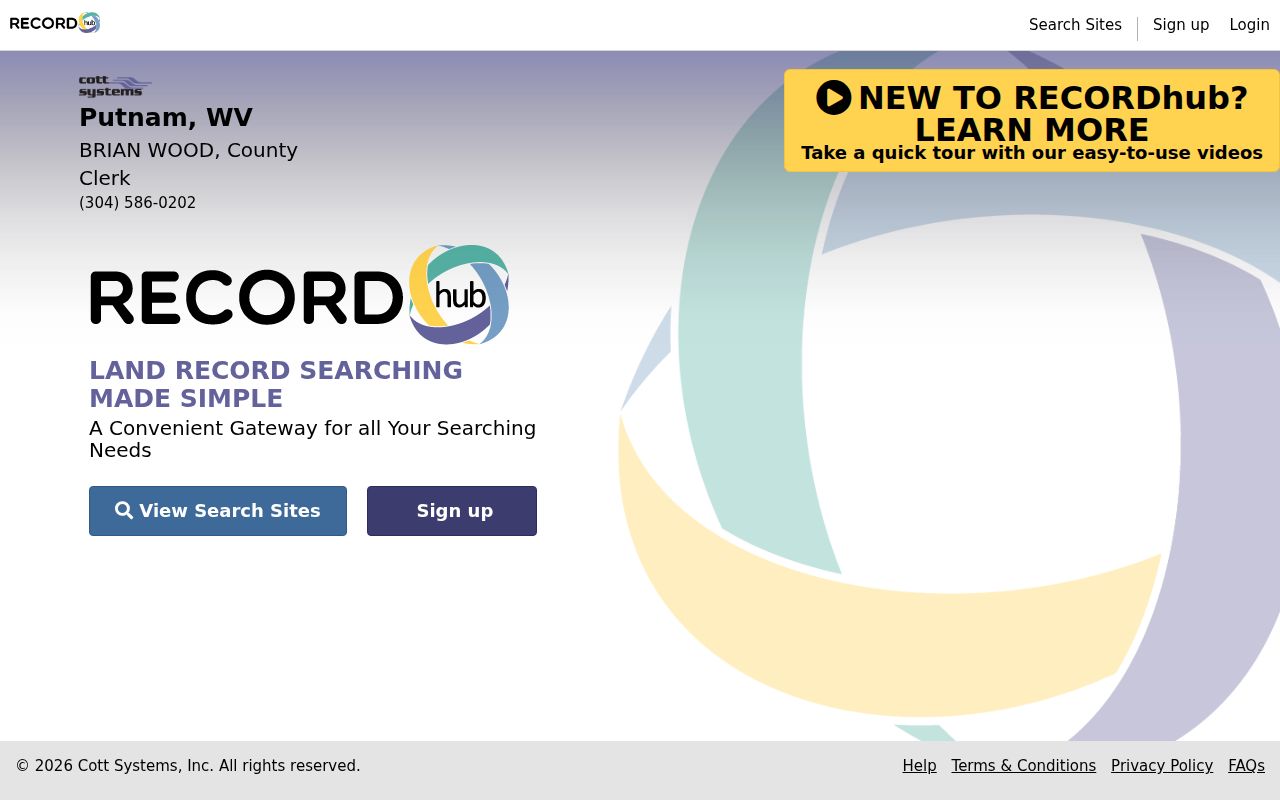
The captured portal confirms the correct county doorway, while its visible public page also shows why researchers must ask the Clerk about historical cutoff dates and image access.
- Grantor and grantee
- The grantor transfers an interest; the grantee receives it.
- Chain of title
- The linked sequence of recorded transfers for the same property.
- Legal description
- The recorded lot, block, boundary, or tract wording that identifies land more reliably than a street number.
- Criss-cross directory
- A directory arranged by street and number rather than only by surname.
Bridge Hurricane Records Offline
Online and historically held are not the same. Putnam County began in 1848, and WV Archives lists deeds from that year, wills from 1847, court orders and surveyor records from 1848, plus later tax and fiduciary material. RECORDhub's undisclosed web cutoff makes the older index an essential backstop. Ask the Clerk whether a book is online, available at a courthouse terminal, supplied by mail, or best found on Archives microfilm.
If an ordinary office page does not answer a precise records question, West Virginia FOIA permits any person to request a reasonably specific public record. The custodian generally has five days, excluding weekends and holidays, to respond. Actual reproduction cost may be charged, but not search, retrieval, or staff time. Name the parcel, book/page if known, document type, and date range. A focused request is easier to route than a broad demand for every record tied to an address.
Insider tip. Ask the Clerk for the present web start date, image access rules, and the procedure for retrieving an older deed book.
Hurricane Lots Outlast Street Numbers
A street address can change or be written in a form that no modern search accepts. No official Hurricane renumbering conversion table was found. Use parcel geometry, subdivision plats, the legal description, E-911 addressing help, and dated newspaper maps to bridge an old number. Do not assign a change year without a record.
The Asbury House nomination shows why this works. Its property history connects Corbly Addition lots 7 and 8, Block 1, to Deed Book 354, page 740. That combination is much firmer than a name or modern street line alone. It also gives previous residents research a safe model: begin with a historic narrative, extract its recorded citation, and then compare the tract with current parcel geometry.
Hurricane Permits Date Changes
Building records can date an addition, demolition, repair, or inspection even when they do not identify every person in the house. Hurricane's permit form records the project address, property owner, applicant or contractor, scope, estimated cost, and requested work. A permit is valid for six months, with one free renewal. Those dates can explain a sharp change in assessed building area or a newspaper notice.
No public Hurricane permit index was located. Contact city Building and Code Enforcement and give a specific address, work type, and date range. For land outside the city boundary, confirm whether Putnam County Planning or floodplain staff holds the file. A missing county permit does not prove no work occurred because municipal and unincorporated systems are separate.
Match Hurricane Households to Owners
Owners are only part of an address story. A directory entry may name an occupant, spouse, or telephone subscriber, while a census schedule can show household relationships and age context. Hurricane coverage is uneven, and a Charleston regional volume does not by itself place someone in Hurricane. The verified collections and how to read them are covered in the Hurricane city directory material.
- Choose a deed date and inspect a directory from the closest available year.
- Copy the printed street spelling, number, abbreviation, directory year, page, and publisher.
- Check nearby years for a move, death, remarriage, spelling change, or publication gap.
- Pair the entry with the closest public federal census schedule and note its enumeration boundary.
- Return to the deed description, newspaper, probate file, or vital index before deciding two names identify one person.
Older sources may call the place Hurricane Bridge or Hurricane Station. The railroad-era move and the city's 1888 incorporation make both terms worth searching. Enumeration lines may also fall outside today's municipal boundary. Keep the source's original place label, then compare it with the deed and parcel rather than forcing it into a modern map.
Lawful use. Hurricane address history supports genealogy and personal research. Never use it to track, threaten, or harass a living person.
Close Hurricane Previous Resident Gaps
The WVU microfilm catalog lists the Hurricane Breeze from May 23, 1913 to present. Obituaries, legal notices, marriage announcements, club reports, and property notices can connect a name with a date or family. A separate 1921 Blue Book says the paper was established in 1900, but that publication-history claim does not prove every earlier issue survives.
Probate and fiduciary records are useful at the end of a deed or directory trail. Wills, estate settlements, and court orders may explain an heir transfer or why ownership passed without a simple sale. WV Archives lists Putnam wills from 1847 and other early county court material. The County Clerk and relevant county court office can route a named, dated request. No complete official Hurricane cemetery or funeral-home index was located, so those sources should remain leads until checked against a death record, probate file, newspaper notice, or caretaker record.
A good final chronology separates facts from inference. List the date, source, name exactly as printed, address or legal description, and what it proves. The result may show a succession of owners and a partly different succession of occupants. That distinction is the heart of identifying previous residents without overstating what any one record can establish.