
Hurricane Directory Collections Compared
The historical shelf is regional, not a verified run published only for Hurricane. That distinction protects a family tree from a false location. Charleston volumes can help track a person who moved between Kanawha and Putnam counties, while statewide titles may list businesses, officials, and civic groups instead of all households.
| Collection | Years | Where held | Access |
|---|---|---|---|
| Polk's Charleston directories | 1908 to present | Kanawha County Public Library Main Library, third floor | In-library reference; no checkout or hold |
| WV Archives directory runs | Charleston volumes 1874-75 through selected 2016 years; gazetteers 1877 through 1923-24 | WV State Archives | Reference holdings; catalog is not a name database |
| West Virginia city and business directories | 1839-1929 | William & Mary Libraries | Digital database; page access may require an institution |
| Hurricane Breeze | Microfilm from May 23, 1913 to present | WVU WVRHC | Microfilm and selected current e-editions |
| Yearbooks | No complete official run located | Hurricane Public Library lead | Ask staff for a named school and year |
No official catalog inspected identifies a Hurricane-only bound city directory. Treat that gap as a finding. Record a title's stated coverage before using any name or address from it.
Search Hurricane Directory Titles Online
The William & Mary West Virginia directory collection is the best identified digital route for early titles. Its description covers inhabitants, businesses, and civic or social groups from 1839 through 1929. Search Hurricane, Putnam, Hurricane Bridge, and Hurricane Station, then inspect the title page and coverage statement. A database record may be visible while scanned pages require a participating institution.
The captured collection page shows the digital catalog entry and its access route.
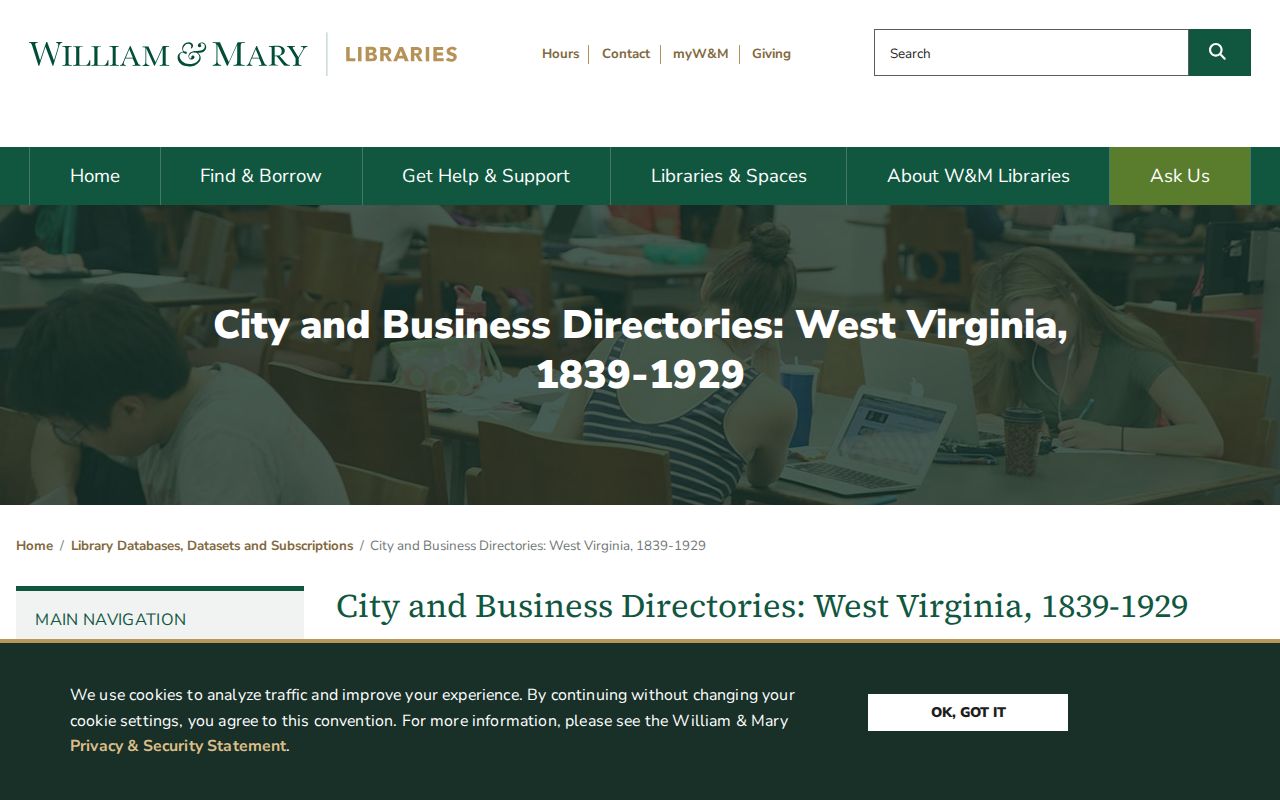
The date span belongs to the statewide collection, not to a guaranteed Hurricane sequence. Check each volume and save its publisher, year, page number, and geographic scope.
When digital access stops, ask the Hurricane Public Library whether it can provide a referral or interlibrary route. Its state profile confirms the branch at 410 Midland Trail, but does not enumerate local-history holdings.
The Hurricane City Directory Gap
A missing Hurricane-only run does not mean local names are lost. It changes the order of work. Start with the library and regional catalogs, move to the Hurricane Breeze, then use deeds, wills, court orders, and vital indexes to verify the person. The Putnam County record trail begins with county formation in 1848, while birth and death reporting begins in the listed county series in 1853.
WV State Archives preserves Putnam deeds from 1848 to 1900, a deed index through 1968, wills beginning in 1847, court orders, fiduciary records, surveyor books, and tax-sale lists. Those are not city directories, but they can place a named person in the county when no annual book survives. Ask for an exact series, approximate year, and known name variant.
No verified full Hurricane yearbook series, church-register list, cemetery database, or local funeral archive was found. A precise request to the branch, Archives, school, congregation, or caretaker is safer than claiming a collection exists.
Browse West Virginia Directory Runs
The WV State Archives city-directory catalog lists a long but uneven Charleston sequence. Holdings include 1874-75, several 1880s and 1890s volumes, scattered early twentieth-century years, and broad coverage from 1954 through 2000 with later selected years. State gazetteers appear in many years from 1877 through 1919 and again in 1923-24.
The official catalog is a shelf guide rather than a searchable address book.
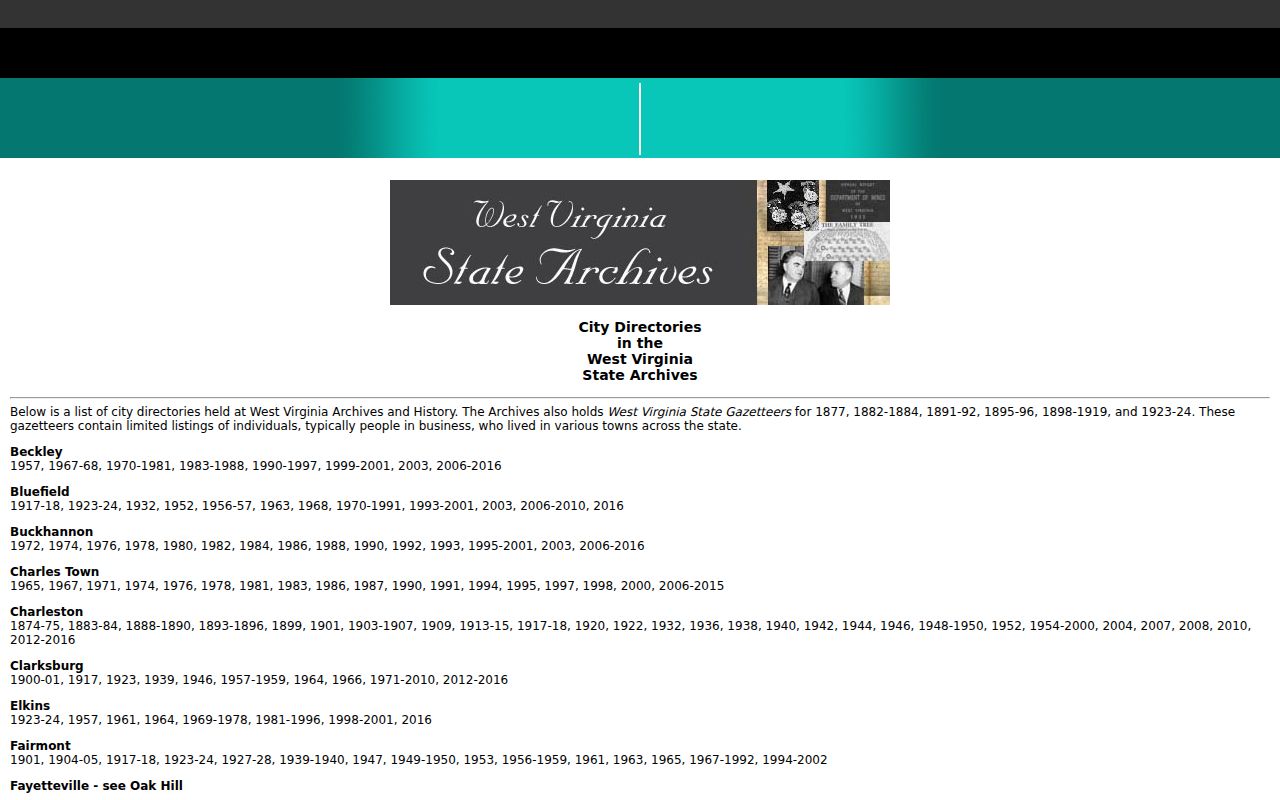
Use its year list to plan a reference request. Ask staff whether the named volume covers neighboring suburbs or Putnam entries, and do not infer Hurricane coverage from a Charleston title alone.
City directory publication gaps also differ from record loss. The inspected Archives page reports no Putnam courthouse fire or total destruction. A missing year might reflect the publisher, catalog, coverage area, or a volume not yet located.
Read a Hurricane Directory Entry
A printed entry often begins with surname and given name, then adds an address and a line for trade or business. Some volumes put a spouse in parentheses, mark a widow or widower, identify the head of household, or use short codes for a person's relation to an address. Exact practice changes by publisher and year.
| Printed name | Copy spelling, initials, suffixes, and order exactly. |
|---|---|
| Relationship mark | Note a spouse, widow, or household notation without expanding it from memory. |
| Street entry | Record number, street spelling, suffix, and any neighborhood label. |
| Trade or firm | Use as identity support, then verify in another dated source. |
| Publication data | Save year, publisher, page, and title coverage. |
- Criss-cross directory
- A section ordered by street and house number, which points from an address to a listed occupant or subscriber.
- Householder index
- An index of named household heads or principal listed people, with rules set by that publisher.
- Abbreviation key
- The volume's own list defining short forms such as residence, boards, or widow notation.
Photograph or transcribe the key before reading a page. No confirmed Hurricane sample page was captured during research, so do not assert that one publisher's symbols apply to every regional book.
Polk Directories Near Hurricane
The Kanawha County Public Library Polk collection covers Charleston and neighboring suburbs from 1908 to the present. The books sit on the Main Library's third floor. They are reference items and cannot be checked out or placed on hold. For a Hurricane family with Kanawha ties, this is useful regional evidence, not automatic proof of a Putnam address.
The library's captured Polk page confirms the date span and in-library conditions.
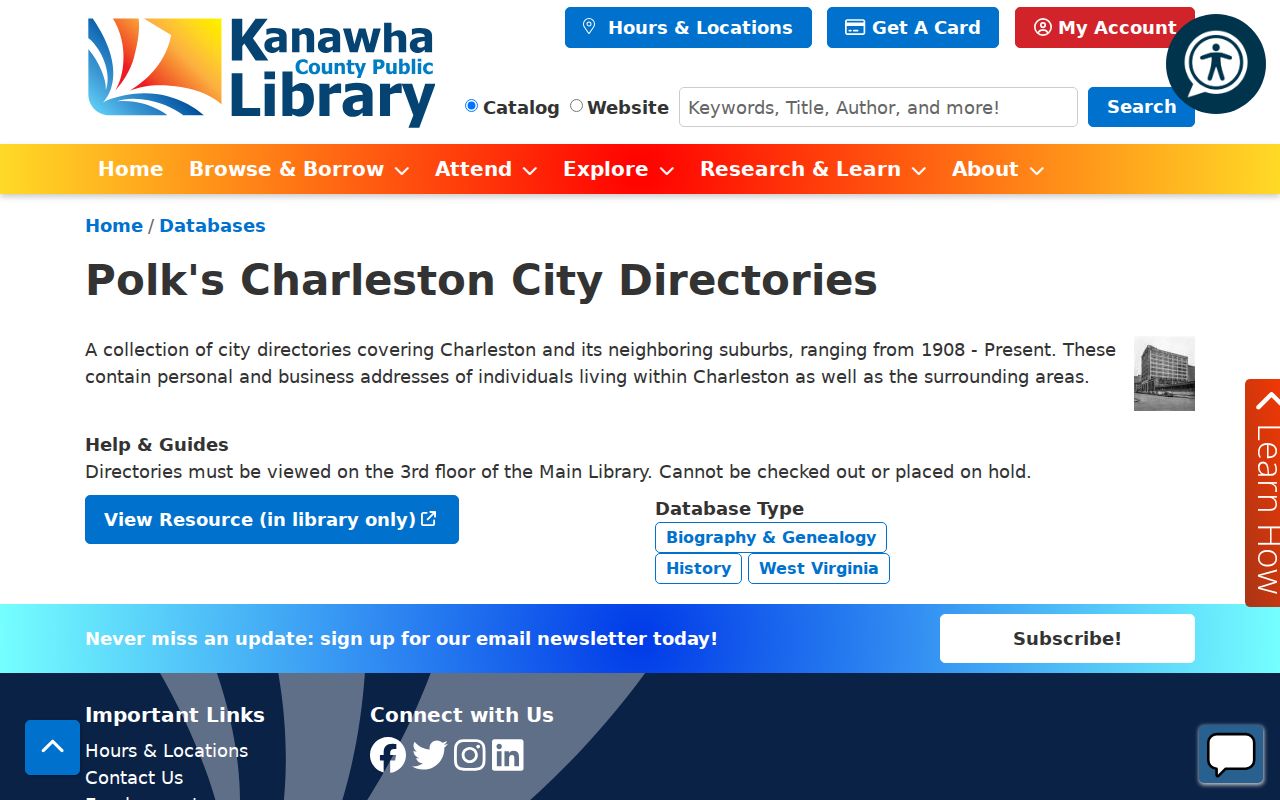
Bring a name, approximate year, known street, and business or family link. Staff at the Local History and Genealogy desk can also route obituary requests and in-library newspaper resources. The desk lists 304-343-4646 and reference@KanawhaLibrary.org.
A city directory find should lead to the next dated source. Compare a Charleston entry with a Putnam deed, census line, Hurricane Breeze notice, or vital index before merging two same-name people.
Search Hurricane's Earlier Names
Hurricane's name history is a search tool. Maps by 1811 showed Hurricane Bridge near the Route 34 and Route 60 area. The railroad shift in 1873 produced Hurricane Station, and incorporation followed in 1888. Older directory, newspaper, deed, and gazetteer references may not resemble a modern postal address.
| Date | Search event |
|---|---|
| 1811 | Maps showed Hurricane Bridge in the area. |
| 1873 | Railroad development shifted the settlement and Hurricane Station came into use. |
| 1888 | Hurricane incorporated. |
| 1913 | The verified WVU Hurricane Breeze microfilm run begins May 23. |
Search all three place forms and retain the date printed on the source. A city directory may use a station, route, or county label. Census enumeration boundaries may also differ from today's municipal limits.
Note: The 1921 West Virginia Blue Book says the Breeze began in 1900, while 1913 is the verified start of WVU's surviving microfilm run.
The Hurricane Breeze People Index
The WVU West Virginia and Regional History Center lists the Hurricane Breeze on microfilm from May 23, 1913 to present. Obituaries, marriage notices, school lists, clubs, legal notices, and property ads can connect a person with a relative, street, or civic role. Recent issues also appear through the paper's e-edition.
The Hurricane Breeze e-edition shows the date-based reading route captured below.
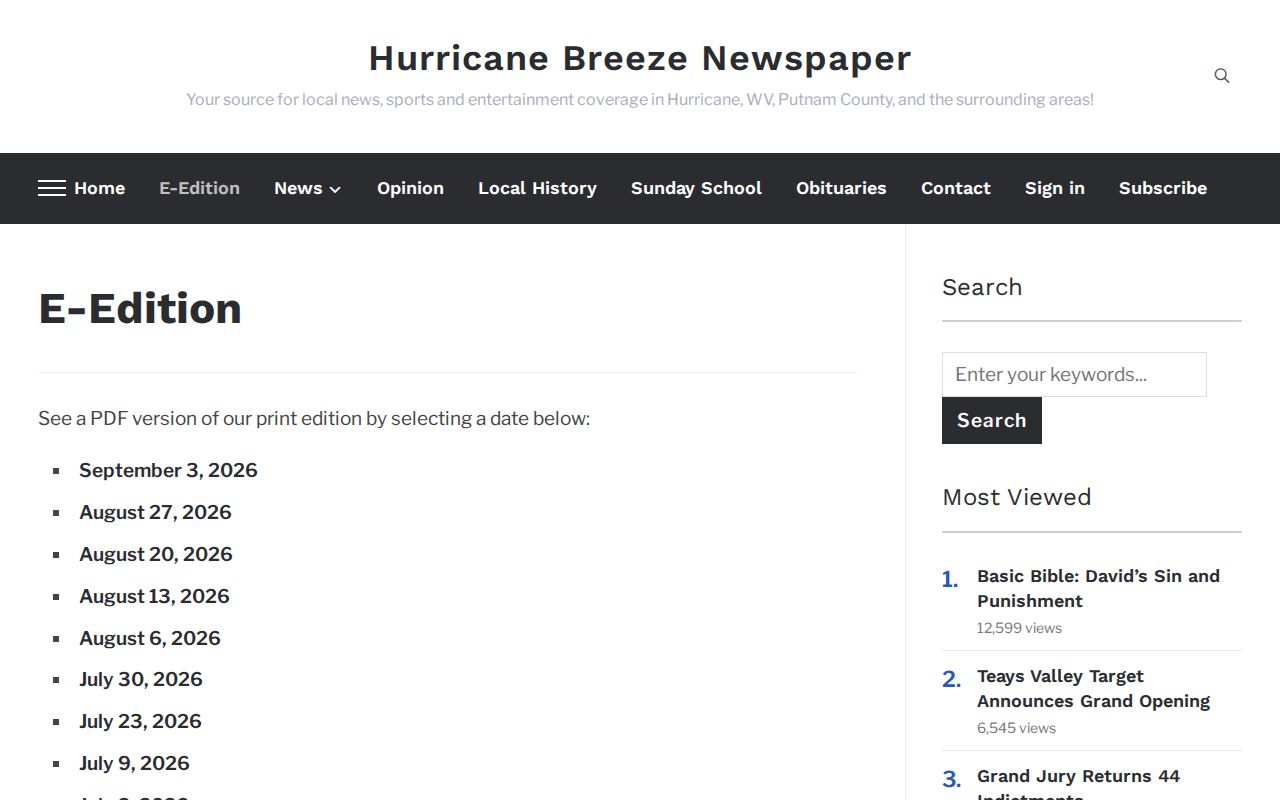
The issue viewer adds recent names and notices, while the WVU microfilm catalog remains the route for the long historical run.
Newspaper coverage changes by date. Search names with initials, maiden or married forms, and place variants. Also try an address, subdivision, school, church, or business. Preserve publication date and page. A notice is a dated statement, not proof that the person stayed at that address.
A Hurricane Breeze report on Upper Vandalia Historical Society is a useful local-history lead.
The article supports the society's local connection, but no official catalog or public membership directory was verified. Ask about a specific subject and do not assume private holdings.
WV Newspapers offers keyword, place, title, and date filters. When a scan is absent, request the microfilm issue from WVU. An obituary can close a directory trail by naming relatives and dates, then a vital index or probate file can confirm the relationship.
Trace Hurricane Families by Directory
Annual and occasional volumes fill years between federal census snapshots. A directory gives a dated address or business line. A census gives household relationships and age context, but its boundary labels may differ. Used together, they can distinguish a move from a spelling change or publication gap.
- Start with a known name, address, or trade from a deed, obituary, census, school item, or church notice.
- Search the surname list, then the address or criss-cross section when the volume includes one.
- Copy the exact spelling, marks, street form, year, title, publisher, and page.
- Check the volume before and after it, noting a move, marriage, death, changed spelling, or gap as separate possibilities.
- Pair the entry with a released census, deed, tax parcel, newspaper notice, probate file, or vital index.
Federal census schedules open under a 72-year rule. Do not state that a person vanished merely because a name disappears from one city directory. The person may have moved beyond coverage, chosen not to list, changed names, died, or been missed by the publisher.
Modern address-keyed records belong in the Hurricane street directory. Historical books remain best for a dated family or house trail.